


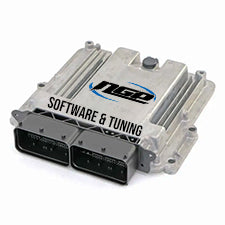

Whenever a first time ECU or TCU customer comes into one of our shops, we typically get asked a similar series of questions. There's nothing wrong with this mentality at all. While ECU and TCU tuning are much more common today, it's not the easiest concept for everyone to grasp. If you do have questions, there's nothing wrong with trying to learn more. We appreciate people taking the time to ask questions because it shows that you are trying to educate yourself more about your car.
Because we get asked these questions so much, I thought it would be a good idea to put together a guide that covers the ins and outs of tuning and what changes are being made to your car. Even if you have a lot of experience with tuning, I still encourage you to give it a quick read; you might just learn something.
While we specialize in working with German vehicle brands such as Audi, Porsche and VW, the information in this guide is applicable towards any vehicle with either a forced induction (turbocharged or supercharged) or naturally aspirated engine. This is because engines operated on the same principles regardless of who manufacturers them.
What changes are being made to my car with tuning?
This depends on whether we're talking about ECU or TCU tuning, so I've broken the answers into different sections:
ECU Tuning Changes - Turbocharged and Supercharged Engines
In a turbocharged or supercharged car, tuning will allow boost levels to increase beyond the factory limitations. This is done by allowing the wastegate to remain closed more to increase the amount of boost. The regulation of the diverter valve is also changed so that more boost can be sent into the engine.
The amount of fuel being injected will also increase to compensate for the increased intake air. Typically this will allow for an improved air to fuel ratio that results in more power. The ratio can also be made more efficient for the times when less performance is required, such as when cruising on the highway. In addition, on direct injection engines, the timing will be altered to provide fuel at the exact moment it is needed. Finally, injected fuel quantity can also be increased to cool off increased temperatures as well.
In some tunes, the throttle system will be refined to allow more boost into the intake valves. With some tunes, you can also expect an improvement to overall throttle response. This may be in the form of sharper acceleration changes such as when you quickly jab the pedal, but it can also alter the acceleration curve so that it occurs more smoothly.
Finally, the ignition timing will be advanced to a more optimum point as well. The ignition timing advancing occurs due to higher cylinder pressure, which necessitates an
ECU Tuning Changes - Naturally Aspirated Engines
If you have a naturally aspirated vehicle, you'll probably note that the gains aren't as big with ECU tuning. This is primarily because they don't have a turbocharger or supercharger that can be told by the tuning to create more boost. Instead, tuning on N/A engines often increases performance by optimizing the fuel/air mixture, advancing the timing and raising the rev limit.
While N/A tuning doesn't present huge increases in horsepower, it often greatly improves the powerband in the middle and at the top end. Some N/A tunes can also increase performance if you have installed new hardware, such as an aftermarket intake, intake manifold, throttle body, headers or exhaust system. However, different engines have different hardware needs, so its best to check with your tuner to learn what extra hardware is needed.
TCU Tuning Changes
First, the shift points for your transmission are changed. Typically these will be shifted up (pun intended) a bit further in the RPM range so that the car can be allowed to make more power, and also to ensure that the following gear change will be better placed in the powerband. In most standard drive modes, this doesn't usually change very much, since that mode is more focused on overall drivability and fuel economy. However, in sport mode, TCU tunes will often raise the minimum and maximum RPM levels higher to better provide more power.
Secondly, the clamping forces are increased. This is done to better cope with increased power and allows the transmission to prevent slipping when changing gears. This is similar in effect to installing a stronger pressure plate with a manual clutch. However, with an automatic transmission, it's able to vary this pressure. That way, when you're driving casually you get smoother shifts, and when you're driving harder, you get more solid, direct transfer of power with each shift.
Why didn't my car come this way?
This is probably the question we get asked the most. Unfortunately, the answer is multi-faceted.
The first reason is that vehicle manufacturers have certain emissions targets they have to hit. In the US, these emissions requirements are placed on the manufacturer by the EPA. They also must meet these requirements at any level, whether the vehicle is idling or at redline in the top gear.
Another reason is due to the warranty the manufacturer has to honor. They have to engineer the engine and transmission so that you can fully max it out at maximum RPM, and in any gear under any driving situation that you will encounter on the road. Manufacturers do not want to have to be constantly replacing parts under warranty. This is why a lot of German manufacturers such as Audi, Porsche and VW will often over-engineer their engines and transmissions, leaving you with performance to be gained by aftermarket ECU and TCU tuning.
Will my fuel consumption increase with a tune?
This depends on the engine, the hardware requirements for the tune, and whether its a forced induction engine or naturally aspirated engine.
Forced Induction Engines (turbocharged/supercharged)
With most stage 1 or stage 2 tuning, your fuel economy will depend on how you drive your car. If you constantly put your foot down on the throttle to enjoy those sweet, sweet turbo spool sounds, your fuel economy will be worse. If you drive your car normally, you can typically expect about a 10-15% increase in fuel economy.
Stage 3 fuel economy will typically drop across the board even if you are driving normally. That's because stage 3 tuning is typically designed to be used with a larger turbocharger or supercharger. A larger turbocharger or supercharger means more air is being pumped into the engine, and more air means more fuel is needed to achieve the proper combustion ratio.
Naturally Aspirated Engines
Typically for most N/A engines, you can expect a decrease in fuel economy. This is because in order to make more power, the engine will require more air. You can only get more air into the engine by increasing the intake manifold volume, adding a more efficient air intake, or increasing the capacity of the engine. Even if you don't install new hardware, N/A tuning will typically increase the fueling at any given point in the powerband to produce a better air to fuel mixture for making power.
Will tuning cause more wear to my vehicle?
The short answer to this question is no, it probably won't. The reason we have to say probably is because the main factor that actually increases wear and tear on a vehicle is the person driving it. If you're simply driving the car normally and occasionally push the envelope every now and then, you're not going to substantially wear out your engine if at all.
On the other hand, we've seen cars with factory levels of power that have had premature wear on the engine and transmission simply because their owner thought it would be a good idea to drive it like they stole it all the time.
As long as you respect your car and aren't constantly pushing it to the limit (which you shouldn't be doing on the street), you will continue having fun in your car for many years to come. Several of our employees have owned vehicles with ECU tuning installed for well over 200k miles and they are still driving strong.
Proper maintenance also plays a big hand in engine wear as well. We see a significant number of vehicles come into our shops with engine issues caused by neglected maintenance. Adding more power and ignoring proper maintenance is a recipe for disaster. You need your engine to be in good working condition if you expect it to properly make more power without causing an issue.
Will Tuning Void My Warranty?
Once again, the answer to this is not straight forward. If we're talking specifically about your powertrain (engine, transmission, and everything that puts the power to the ground), you warranty can be voided, provided that the manufacturer can prove the tuning was the cause of the issue. Some dealerships are better at dealing with this than others, so we recommend checking with the local community to find out their experience with this.
It's also important to note that while a manufacturer can deny warranty on your powertrain equipment, it still has to honor the warranty on the other sections of your vehicle. This means that if your heated seats or GPS stops working while you still have warranty coverage, they cannot simply deny your warranty because you have ECU or TCU tuning installed. In the US, you're also protected by what is known as the Magnuson–Moss Warranty Act, which means that they must prove that your modification (ECU/TCU tuning) caused the issue before denying your warranty claim.
TD1 Flagging
More modern vehicles are equipped with a flash counter, which tells the manufacturer how many times the vehicle's ECU or TCU have been re-programmed. The manufacturer can check this information against their own records to see if the ECU or TCU have been re-programmed outside of their own facilities. Once a dealership connects to your car with their diagnostic computer, it immediately makes the comparison and logs it on the manufacturer's servers. If the numbers don't match, the vehicle is flagged with a TD1 status. This status lets anyone servicing the vehicle know that it has been modified.
Tuning With a Warranty
Some aftermarket tuners, such as APR, can provide a warranty with their tuning. These tunes typically cost a bit more than a standard tune to cover the cost of the warranty being provided. The warranty will essentially take over the remainder of your factory warranty and provide coverage for your powertrain.